Showing posts with label Astronomy. Show all posts

The Highest Peak Moon Beyond the Everest

Posted by arihermawan4121 on Monday, November 29, 2010

Moon Highest Peak
Forum for the Lunar Reconnaissance Orbiter (LRO) is NASA's orbiting the moon was successfully demonstrated the highest point in months. The point is the plateau near the crater Engel'gradt which has a diameter of 27 miles. 
 Known, the elevation is 35,360 feet (about 10,000 meters) or approximately 6400 feet (1938 meters) higher than Everest.

LRO has a tool capable of firing a laser beam that measures the height of the lunar surface. Data from this LRO compared with the moon's surface stereo images taken on August 12, 2010. The way it enables scientists to precisely measure the height and the coordinates of the highest point in this month.


Altitude are found in this observation is calculated relative to the average height of the lunar surface. The way it is because scientists do not have a reference to determine the altitude of the moon, not like measuring height on Earth which depends on the sea surface.


In contrast to the geological setting of Everest that took tens of millions of years, the highest place in this month is expected to form in just minutes. This place is formed as a result of asteroid strikes the moon's south pole about 4 billion years ago.
More aboutThe Highest Peak Moon Beyond the Everest

Temperature 10 Trillion Degrees Celsius

Posted by arihermawan4121 on Wednesday, November 10, 2010

Imagine what it's like the Sun's surface temperature even the sun's core up to trillions of degrees Celsius? Scientists working at the European Nuclear Research (CERN) in fact has recently succeeded in creating a temperature of 10 trillion degrees Celsius in the Earth.

But do not imagine that temperature in an open free Rungan. Such high temperatures created in the reactor Large Hadron Collider (LHC), the giant instrument of high-energy particle accelerator, located on the border of France and Switzerland. This is part of research to understand the formation of the universe that is based on big bang theory.

With the LHC, scientists from several institutions collaborated to do a study to create quark-gluons plasma, one might say a kind of mixture of sub-atomic particles (quarks and gluons) that melts as the temperature is very high. Plasma is made with high-speed crash tin ions simultaneously. Shots that produces a phenomenon called "big bang" mini at the LHC. In a mini big bang, the ball-of-mass fireball high type and a temperature of about 10 trillion degrees Celsius is created.

"At these temperatures, protons and electrons that make up atomic nuclei to melt and produce fire balls of mass type and high temperature plasma gluons called the quark," said David Evans, a researcher from the University of Birmingham who are involved in the mission.

Research on the plasma is very important to understand about the expected plasma formed a millionth of a second after the Big Bang happened 13.7 billion years ago. Through this study, researchers also can learn more about the style of a "binding" of atomic nuclei and determine 98 percent of the mass of the body.

Prior to the study of plasma using the LHC, quark-gluons plasma have also been studied using the Relativistic Heavy Ion Collider (RHIC) in Utah, New York, USA. However, researchers who publish their work on February 10, 1010 and had only managed to create plasma with a temperature 4 trillion degrees Celsius.

During the coming week, researchers at CERN will still be trying to learn the results of experiments. After that, they will return to the mission of firing protons which also aims to understand the formation of the universe.
More aboutTemperature 10 Trillion Degrees Celsius

New Comet Findings Amateur Astronomer

Posted by arihermawan4121 on Tuesday, November 9, 2010

Ikeya Murakami

A new comet, named "Ikeya Murakami" (C/2010 V1) was recently discovered by a Japanese amateur astronomer. Following up on that discovery, a Russian astronomer named Leonid Elenin trying to observe the comet using a telescope-NIM Ison located in New Mexico, USA.

"Shortly after the observations, C/2010 V1 looks like a ball of light, invisible image details," said Elenin after making his first observation as reported by Space.com, Monday (08/11/2010). However, after several days of observation, the exterior of the comet's head disappeared. "I was disappointed.'s Comet was very quick to change," said Elenin.

However, Elenin managed to see the inside of the head of the comet or coma. "I can see the inside of the comet's head. Appearance as a comet 17P/Holmes after its explosion in 2007. I also can see a long tail and bright," said Elenin.

Comet Ikeya Murakami in the observations appear to be near Saturn's rings. Luca Buzzi and Andrea Aletti from GV Schiaparelli Astronomical Observatory managed to capture the comet with the planet Saturn on November 5, 2010.

"I am very impressed with the discovery of this amateur," said Buzzi respond to the discovery of this amateur. He who at that time was doing routine tasks at the center of his observations said, "This discovery is very nice. In the modern era that a lot of research is dominated by large, there are amateur discovery."
More aboutNew Comet Findings Amateur Astronomer

O'Brien From Space For Earth

Posted by arihermawan4121

Brian J O'Brien
Earth, says Professor Brian J O'Brien, like a spacecraft that is very valuable. When viewed from space, Earth is really small, even just a point between the various planets and stars. Although small, this is the only planet known to live.

This awareness is not just a doctrine of a trust for Brian J O'Brien, former Principal Scientist of NASA (National Aeronautics and Space Administration) that runs the Apollo project in the 1960's.

Around this time he also recorded as a teaching space science at Rice University, Houston, Texas, by Buzz Aldrin, one of his students who later became astronauts who landed on the moon with Apollo 11.

Fully aware of the fact that O'Brien chose to focus and encourage improvement of environmental quality. Since 1991, over seven years, father of three children became the First Director and Chairman of the Environmental Protection Authority for the Western Australian Government. After that, consulting firms engaged in environmental strategies, Brian JO 'Brien & Associates Pty Ltd, was established.

"Now I can do whatever I want," he said.

With his company, O'Brien 10 also encourages the publication of the relevant regulations of environmental protection in Western Australia. Some of the rules concerning water management, pollution, mining, and environmental ethics for business and tourism.

And Apollo Moon Dust

Environmental issues are also a concern O'Brien returns to the moon dust that has been detected since 1969, when the first human landing on the Moon with Apollo 11. Moreover, U.S. President George W Bush (then) could catapult the discourse continued mission to the Moon in 2020.

Data on the Moon dust has been taken since the Apollo 11 mission, Apollo 12, Apollo 14 and Apollo 15. Until now, O'Brien said, there are approximately 30 million digital data about the moon dust. Data on the Moon dust is transmitted to Earth every 54 seconds when the Apollo missions 11, 12, 14, and 15. However, until the project closed on September 19, 1977, no one has analyzed the problem of dust this month.

In fact, the dust is very troubling research team of Apollo on the Moon. Moon dust characteristics very different from the dust on Earth. Moon Dust and the more sticky the sticky afternoon. In fact, Moon dust attached to the seismometer weighing 47 kilograms body mounted on the Apollo 11 as high as 17 meters, also in clothing space. Because sticky, dust it inconvenient research.

To reduce dust levels of stickiness, O'Brien said, landing on the Moon is always in the morning or at the new moon. This dust problem should be considered in the project of human landing on the Moon in the future.

To monitor the dust, O'Brien makes detectors dust (dust detector experiment) simple use of solar cells. According to him, the sun produces electrical voltage. The presence of dust will create a voltage drop.

Dust detector was used on Apollo 11, Apollo 12, Apollo 14 and Apollo 15. Two-dust detector used in the Apollo 11 and 12, even brought and shown to the students who followed O'Brien delivered a guest lecture, beginning last October at the Institute of Technology 10 November Surabaya.

Logically, said O'Brien, the hard object collision will cause the particles apart. However, the presence of dust Months are sticky and very disturbing that the study was under-estimated the scientists. Nevertheless, he continued, NASA did not pay too much attention is Moon dust problem. On Apollo 13 and beyond, NASA is only provided cleaning brush.

Now, many notes on the research of Apollo, but tucked Moon dust. Moreover, most project participants had died. One who still keep a record of it is O'Brien, who had received awards from NASA for outstanding achievement in science.

Aurora

O'Brien also interested in the aurora. Beautiful light tinge that can be found in winter in an area close to the north or south pole, according to the grandfather nine grandchildren, due to battle the Sun's magnetic field and plasma. Energy is transferred from the interplay of magnetic fields to the particles that make auroras.

This was the discovery in 1967 after trying to make a gauge aurora-forming particles and energy. In the notes Rice University, 1967 Aurora First satellite launched to study the aurora. The satellite was built O'Brien with his student, Curt Laughlin and Paul Cloutier, who is also professor of space physics and astronomy. The device is made with spare parts which he worked alone.

The research project to measure the auroral light and energetic particles in fact already started in 1963. At that time, as written in www.media.rice.edu, made satellite, called Sammy I, II, III, and IV according to the campus mascot Sammy The Owl. The first satellite was launched in 1964.

From the study, known to affect the Earth's magnetic field unlike the magnetic field generated bar magnet is symmetrical. Plot is very different because the Earth is also influenced by solar radiation. The results of this study also changed the way scientists about the Earth's magnetic field.

From a variety of knowledge about this space, O'Brien and the world community is fully aware that the Earth is a small part of the universe. The realization that the Earth as the only planet known to be inhabited and surrounded by empty space, making people increasingly appreciate the environment.

"I like talking with the enthusiastic students (and interested in space and the environment). Age I'm 76 years old, 'battery' in this self must always dicas, and it's you who mengecas 'battery' that," he said.
More aboutO'Brien From Space For Earth

The figure of Comet Hartley 2

Posted by arihermawan4121 on Monday, November 8, 2010

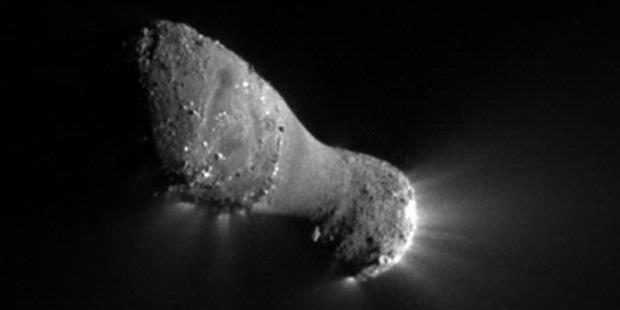
After a 4.6 billion mile journey through the chase, the vehicle NASA's EPOXI spacecraft successfully moved toward comet Hartley 2 and send close-up image of a comet into the Earth that were recorded from a distance of 700 kilometers.

At first glance, his appearance showed that the comet Hartley 2 has a shape that has never encountered before. Comet that has a shape like a nut, the middle of a thinner and smoother separates the two parts of the polar ends or comet that is more thick and coarse. Its size is estimated with a length of 2 kilometers and threshing in the middle of 0.4 kilometers.

Meanwhile, the back of the comet looks like the exhaust of combustion in jet aircraft. As comets generally, there is a tail of gas that occurs due to evaporation of the comet material (gas and dust) due to the movement of the comet approaches the Sun.

"We think, form bean can be obtained since the end of the core nucleus is much evaporated. The result of evaporation it is possible to accumulate and clot in the end," said Jessica Sunshine, one of the researchers involved in analyzing the mission of this comet, as reported by National Geographic site , last week.

Furthermore, Sunshine says, "In the middle of no visible activity evaporation at all." Sunshine speculated, the center of the fine is the part that is filled by the evaporation of material generated in the polar comet comet. The result of evaporation and dust are attracted to the center of the comet due to gravity.
More aboutThe figure of Comet Hartley 2

Ten New Galaxy Clusters Discovered

Posted by arihermawan4121 on Sunday, November 7, 2010

The universe will look more solid every day. Planets, asteroids, stars and galaxies are found every year in considerable amounts.

Discovery web site today to preach about the discovery of 23 clusters of galaxies or clusters of stars consisting of several galaxies by the Atacama Cosmology Telescope (ACT). Among the 23 clusters of galaxies found in it, 10 of which were new galaxy clusters. The findings will be reported in the Astrophysics Journal, which will be published on 10 November.

Mission discovery of new galaxy clusters was started in 2008. The researchers used the ACT technology that would collect microwaves to be able to image the galaxy clusters that want to be found. They chose the Atacama Desert in Chile as a place of observation for the ACT work is not much disturbed because a lot of water vapor.

"Observations in the Atacama, led by Luman Page of Princeton University is a mission to find the 'shadow' which is intended for scientists as clusters of galaxies," said Felipe Menanteau, researchers from the School of Arts and Science, Rutgers, reveals that the purpose of observation.

The shadow in question is the shadow that tercitra galaxy clusters in the ACT. The shadow is created due to the hot gas in clusters of cosmic background radiation cosmic cause increased energy. As a result of that incident, and clusters of galaxies appear in the form of shadows.

Responding to these results, Priyamvada Natarajan, professor of physics and astronomy involved in the study, said, "The results of this study will build our inventory of parts of the universe's most distant and massive. It will also provide an important challenge to the model of the cosmos are now accepted. I am proud of these findings. "

A number of researchers involved in this observation, in addition to Menanteu and Natarajan, is Jack Hughes of Rutgers and Jorge Gonzalez from the Pontifical Catholic University of Chile (PUC).
More aboutTen New Galaxy Clusters Discovered

New Signs That Mars Could Occupied

Posted by arihermawan4121 on Saturday, November 6, 2010

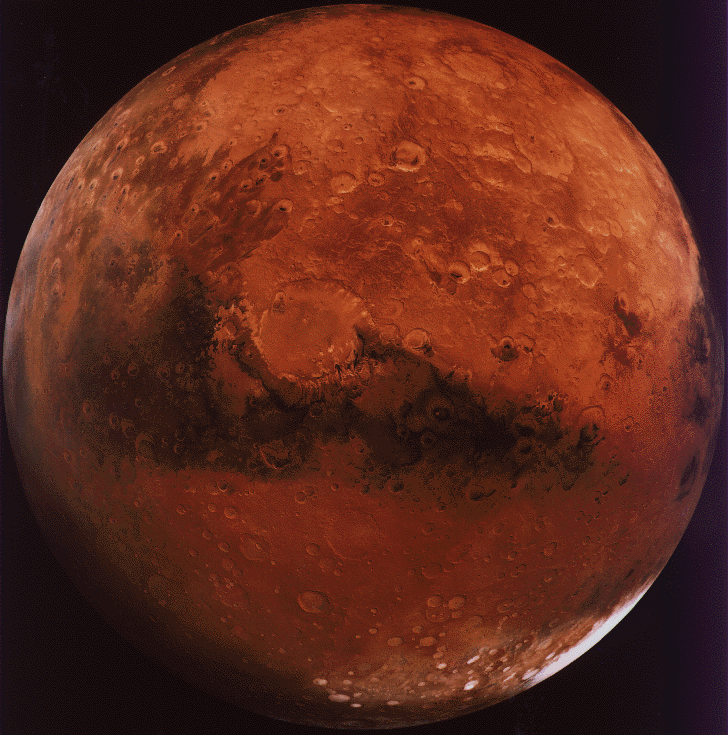
Search for new planets that can be inhabited still not stopped. Long missions, such as looking for signs of life on Mars and the possibility that the planet could be habitable until now is still running.

Using a spectrometer from NASA's Mars Reconnaissance Orbiter, researchers from Brown University recently discovered a mound of mineral silica on Mars. They found him in the planet called Syrtis Major, precisely in the area Nili Patera volcano is 3.7 billion years old.

Looking at the existing location near the volcano, researchers speculate that the mounds of silica is derived from hot springs that never existed in the region. Mounds were formed when hot water came out and dissolve the rock, making it rich in silica minerals from rocks. As the water cools down and in contact with air, called hydrated silica material is formed and set mound that is now found.

The presence of silica bumps that come from this hot spring, according to the researchers, is one sign that there is a small neighborhood on the Red Planet uninhabitable. "When you have water and heat, as found in this place, you have the opportunity to live and live," said John Mustard, a professor of geology who are involved in this research.

Other researchers, JR Skok, who also came from the same university, suspect that the existence of hot springs indicates that at least, there was a primitive life, such as microorganisms. If the hypothesis is true, then he reveals, "It would be possible to find a collection of fossils of microorganisms in the region."

So far, there has been no real evidence about the existence of life on Mars. However, the findings of silica on Mars is not the first. The findings had previously been conducted in 2007 by NASA's Spirit Mars mission. The uniqueness of this finding is the presence of silica mound intact.

The results of this study was published by John Mustard and JR Skok in the journal Nature Geoscience October 31, 2010. In the future, researchers hope to detect how is it possible this environment for occupancy, for example by looking at the temperature and acidity.
More aboutNew Signs That Mars Could Occupied
Related Posts Plugin for WordPress, Blogger...